Mickaël ABÉLARD
Managing Director & Senior Social Innovation Consultant



The aim of this training course is to equip participants with the skills needed to effectively structure and lead service co-creation and co-construction workshops, while respecting collaborative methods and stakeholder expectations.
At the end of this course, participants will be able to :
This course is designed for professionals:
This training course is also aimed at jobseekers, current employees, those planning a career transition or retraining in the field of collaborative working or innovative and/or collaborative project management.
There are no specific prerequisites for this course. However, initial experience in project management or team leadership is a plus.
Sessions take place once every 2 months. Information on dates and locations is available by e-mail at contact@axone-consultant.com
The training course is scheduled over 3 days with a total of 21 hours, broken down as follows:
This duration is optimal for quality training, allowing sufficient time for the acquisition of theoretical knowledge, practical situations and feedback.
The 21 hours of training are organized into 3 thematic modules for a total of 21 hours, i.e. 3 days, organized as follows:
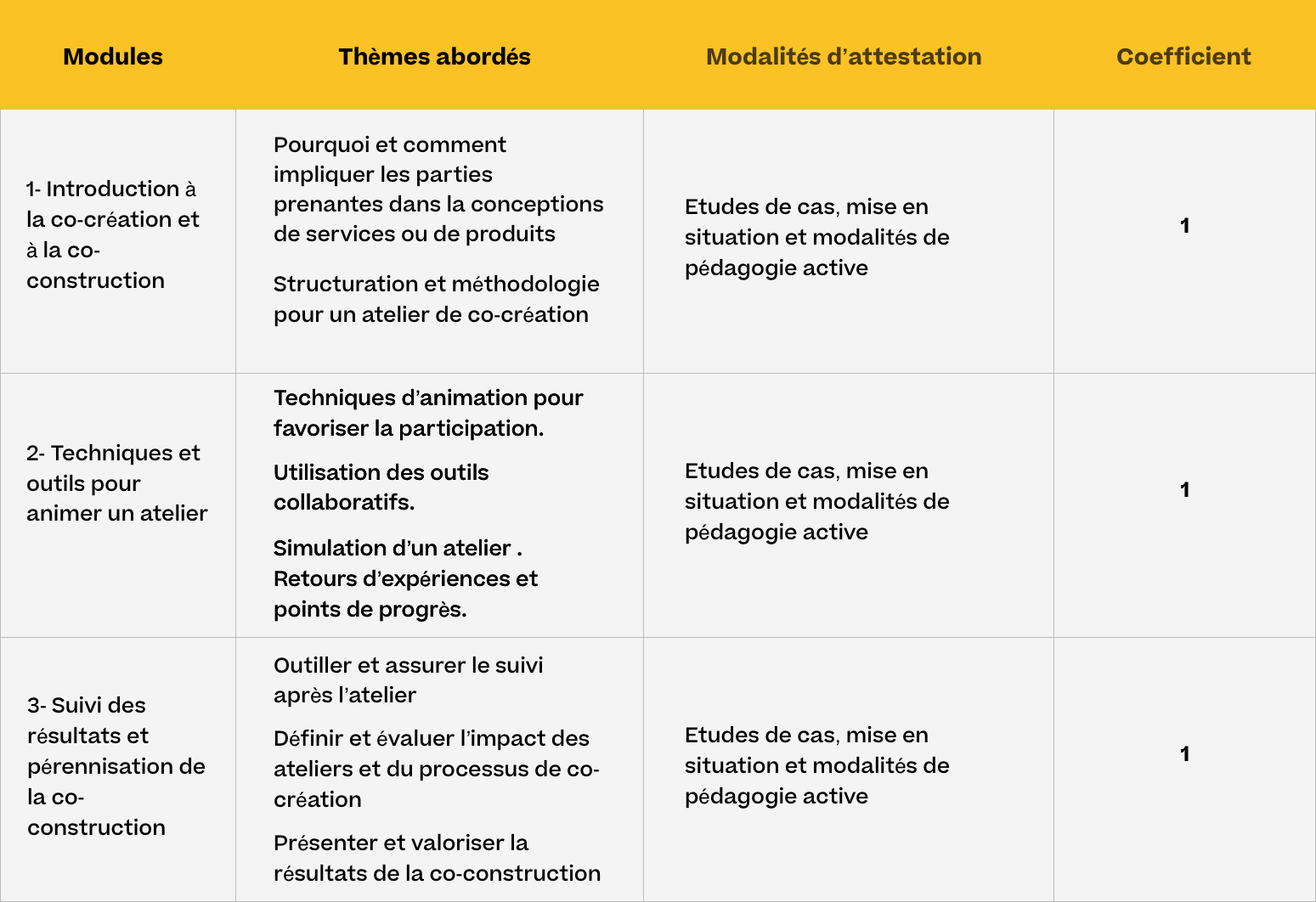
The course alternates theory, concrete examples and practical application. Collaborative workshops are offered every day to put participants in real-life situations.
The attestation procedures are scheduled throughout the training module, and are validated by the successful completion of case studies, exercises and practical cases. Successful completion of all modules is rewarded with a personal ERO badge corresponding to the training module, available in PDF and digital format at the end of each training module. A training certificate will also be issued to all participants.
Completed vocational training agreement and registration form. No application fee is required. However, incomplete applications will not be accepted.
Candidates have a withdrawal period of 10 days following notification of enrolment. If the cancellation request is received after this period, a compensation fee of 100 euros will be charged. Cancellation requests must be sent by registered mail with acknowledgement of receipt.
The course is not accessible to people with visual or hearing impairments, or with multiple or multiple mental handicaps.
1,630 euros per person, incl. VAT, for all modules. Modules cannot be selected separately. Breakfast, morning and afternoon breaks and lunch for each day of training are included in the price. For training courses held outside La Réunion, travel and accommodation expenses are extra, according to terms to be agreed between the parties.


Mickaël ABÉLARD
Managing Director & Senior Social Innovation Consultant

Jimmy Bègue
Consultant in Community Life and Territorial Catalysis

Samuel ABLANCOURT
Scientific Director

Innovance ESS